
Walker County Release Date Types
A projected release date is TDCJ Classification and Records' estimate of release from incarceration if parole does not occur sooner. Offense date, offense type, sentence structure, time credits, eligibility rules, and Board action can affect it. The exact Texas label is “Projected Release Date.” A maximum sentence date points to expiration of the sentence calculation. Parole eligibility is only the first date on which Board consideration can arise.
The actual release date records physical departure from the holding agency. Discharge is different again. A person released on parole or mandatory supervision is outside prison while the sentence continues. Discharge means that sentence, including applicable supervision, is complete. Mixing these dates can produce a false timeline.
- Projected release date
- TDCJ's current calculation of a possible release from incarceration.
- Parole eligibility date
- The first point at which a case may be considered under the applicable rule.
- Actual release date
- The date custody was physically ended or transferred as recorded by the agency.
- Discharge date
- The end of the sentence, including required supervision.
Choose Walker County Release System
Walker County contains one county jail and seven TDCJ prisons, so the word “Huntsville” is not enough to select a database. Walker County Jail holds local pretrial defendants and county-sentence inmates. Byrd, Ellis, Estelle, Goree, Holliday, Huntsville, and Wynne are state facilities. Their state release calculations do not come from Walker County Odyssey.
A county detainee awaiting trial has no fixed sentence-end date. Bond may be posted, a judge may change the conditions, a case may be dismissed, or another hold may block departure. For a short county sentence, jail records staff and the court judgment are the right sources. For a TDCJ sentence, use the official state search and information channels.
| Person's status | Best starting source | Date to seek |
|---|---|---|
| Walker County pretrial custody | Odyssey jail/bond record and court docket | Executed release after bond or order |
| Walker County jail sentence | Jail records unit and judgment | Calculated local sentence end and actual release |
| TDCJ incarceration | TDCJ Inmate Search | Projected release and maximum sentence dates |
| Parole approval pipeline | BPP and Parole Division status lines | Scheduled and actual release |
| Already released from TDCJ | TDCJ incarceration history or record request | Actual release and discharge |
Find Walker County Projected Release
The TDCJ Inmate Search is the main public route for a state prisoner. Search with the seven-digit TDCJ number or State Identification number when possible. A name-only result needs more checks. Compare sex, race, age, offense, conviction county, sentence, and unit before relying on the displayed date.
- Confirm that the person entered TDCJ rather than remaining in Walker County Jail. A transfer entry can establish the change in custodian.
- Search TDCJ by TDCJ or SID number. If neither is known, enter last and first name and refine the identity with available details.
- Open the matching detail and read the location, offense, sentence, parole information, Projected Release Date, and maximum date together.
- Decide which question the date answers. Eligibility is not approval, projection is not departure, and release on supervision is not discharge.
- Use TDCJ's email or telephone channels when the online result is missing, unclear, historical, or disputed.
The official TDCJ definitions explain the date labels used in the calculation.
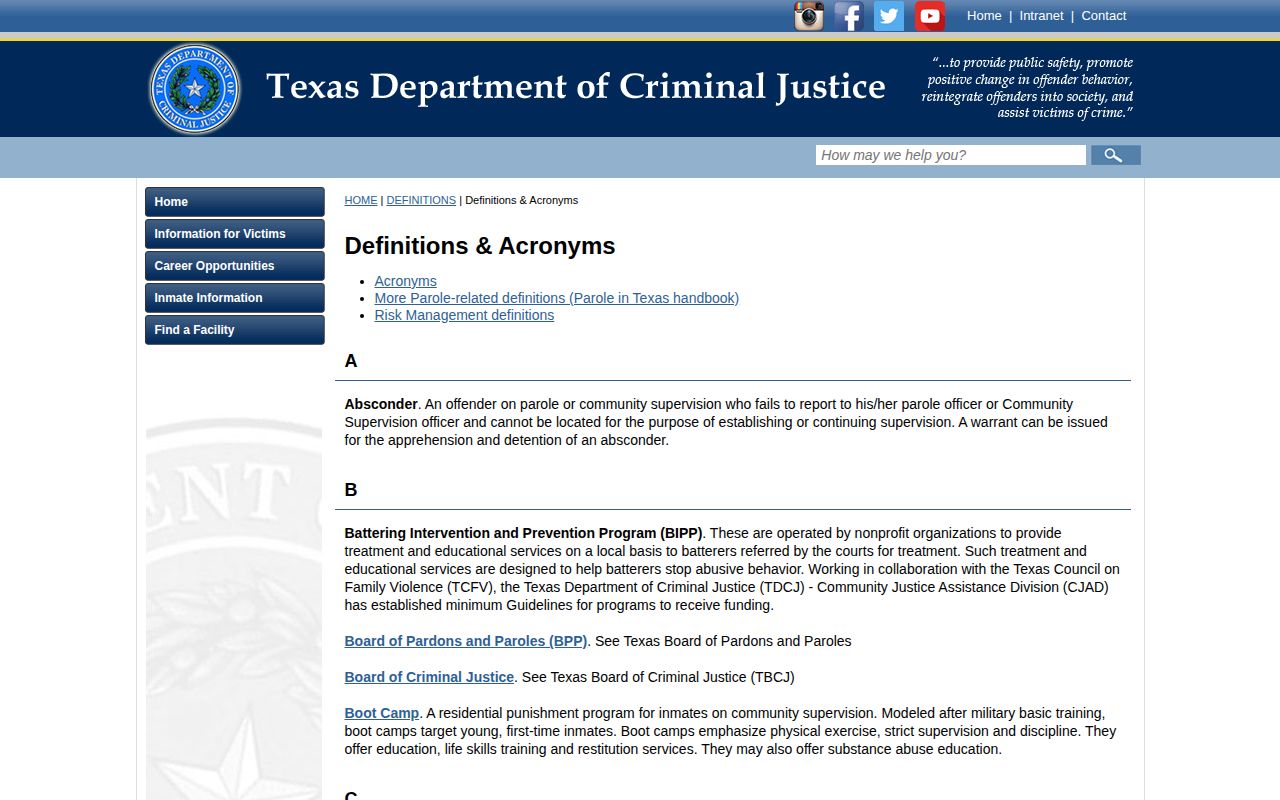
The definitions show why a Walker County search should preserve the exact label rather than calling every future date a release date.
Walker County TDCJ Date Requests
TDCJ offers free email information when the public result does not answer the question. Email pia@tdcj.texas.gov with the inmate's name in the subject. Give the full name and seven-digit TDCJ number. If the number is unknown, provide the exact date of birth, or an approximate age and county of conviction. Available information can include TDCJ number, location, offense, incarceration history, current conviction, court and county, and projected release date.
The general locator lines are (936) 295-6371 and (800) 535-0283. Before a parole decision, the BPP prerelease-review status line is (844) 512-0461. After a favorable vote, the Parole Division release-status line is (512) 406-5202 and requires a TDCJ or SID number or date of birth. This separation helps prevent a favorable vote from being reported as a completed release.
The official TDCJ telephone information page identifies the alternate status channel.
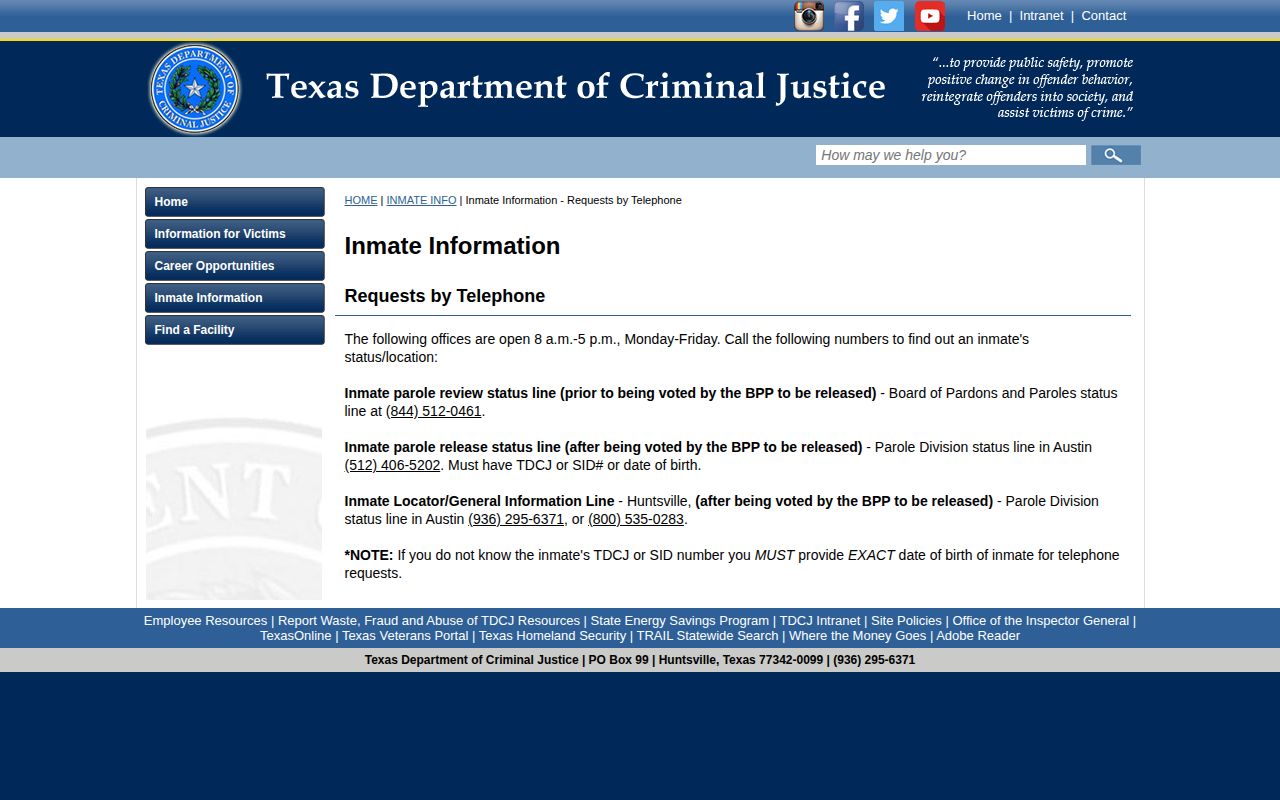
Choose the line that matches the case stage, then ask whether the answer is projected, scheduled, executed, or final discharge information.
Texas Good Time Calculation
Texas Government Code Chapter 498 governs good-conduct time. Section 498.003 creates classifications and permits up to 15 additional days per 30 days actually served for diligent participation in qualifying work, agricultural, educational, or vocational activity. Good time is a privilege, not a right. It affects parole or mandatory-supervision eligibility under the governing law and does not simply erase days from the sentence imposed by the judge.
Section 498.004 permits forfeiture after misconduct. Restoration depends on law and agency policy. A reliable conceptual review begins with the sentence start and jail credit, then considers concurrent or consecutive sentences, offense date, judgment findings, parole or mandatory-supervision eligibility, flat time, applicable credits, lost or restored credits, and Board action. TDCJ makes the official computation.
For many cases under the general parole rule in Government Code §508.145(f), calendar time plus accrued good conduct must reach one-fourth of the sentence or 15 years, whichever is less. Numerous exceptions apply. Eligibility opens a review point; it does not compel release. Mandatory-supervision rules also change based on offense date and statutory exclusions.
Note: Do not calculate an official Walker County release date by hand; contact TDCJ Classification and Records about a disputed computation.
No Texas 85 Percent Rule
Texas has no blanket rule requiring every prisoner to serve 85 percent of a sentence. The shortcut hides the case-specific law that TDCJ must apply. Serious offenses associated with Code of Criminal Procedure Article 42A.054 and an affirmative deadly-weapon finding commonly fall under Government Code §508.145(d). That provision generally uses actual calendar time, without good-time contribution, equal to one-half of the sentence or 30 years, whichever is less. A sentence under four years carries a two-year minimum under that rule.
Other offenses may follow different eligibility formulas. Government Code §508.149 lists mandatory-supervision exclusions and permits denial in covered post-1996 cases when the Board makes the required findings. Capital sentences, life without parole, offense dates, sentence types, and consecutive sentences can produce still other outcomes. The judgment, offense date, statute, and TDCJ calculation must be read together.
The Texas parole and mandatory-supervision law supplies the controlling rules.
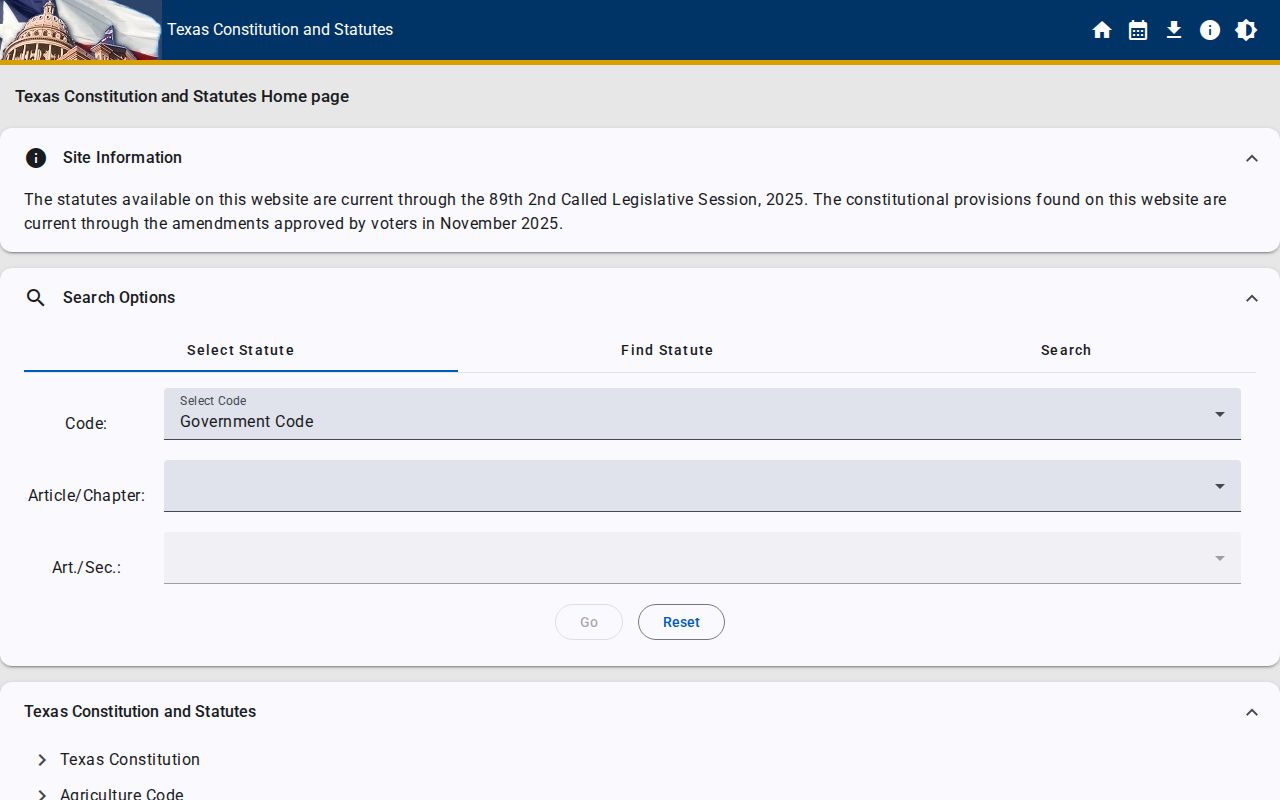
This statute view supports an offense-specific analysis and rejects a one-size-fits-all percentage for Walker County prisoners.
Why Walker County Release Dates Change
A displayed projection can move as the legal or factual inputs change. TDCJ may recalculate after a Board decision, a disciplinary event, a corrected jail-credit entry, a new court order, or a change to sentence structure. A scheduled day can also change because release-plan work, a required program, a detainer, a certificate, or transport remains unresolved.
| Changing factor | Possible effect |
|---|---|
| Good-time loss or restoration | Changes credit applied under law and policy. |
| Corrected jail credit | Changes the credited sentence start or flat-time calculation. |
| Concurrent or consecutive sentence ruling | Changes how multiple sentences are combined. |
| Parole grant or denial | May create a release-processing path or move projection toward maximum expiration. |
| Program or release-plan requirement | Can delay departure after a favorable vote. |
| Detainer or outside hold | Can send the person to another custodian rather than the community. |
| Court order or sentence correction | Can alter the legal term that TDCJ computes. |
A transfer among Walker County's seven TDCJ units is not release. Even a move to Huntsville Unit for regional release processing remains custody until the release is executed. Conversely, release at Huntsville Unit does not mean the conviction arose in Walker County.
Walker County Jail Release Timing
Odyssey supplies Walker County jail and bond access, but it does not publish a guaranteed projected-release field for each local detainee. A person awaiting trial has no sentence calculation to display. A bond order can authorize release while another charge or detainer still holds the person. The court docket explains the legal order; the jail event documents the physical departure.
For a county sentence, compare the judgment, sentence start, credited jail time, and the jail records unit's calculation. Do not transfer TDCJ good-time assumptions to a Walker County jail episode without an official basis. If the online event is incomplete, use the WCSO written records-request route and ask for the actual released date and time, release reason, destination, authority, and any receiving agency.
A disappearance from a current view proves very little. Transfer, a court trip, hospital movement, a different name, or a feed delay can cause the same result. The broader Walker County release record search explains how to pair the jail event with a court disposition.
Confirm Walker County Release Date
TDCJ states that scheduled prison releases generally occur from 8 a.m. to 5 p.m., Monday through Friday except holidays, and that schedules can change. Most people leave from the current unit, while staff may arrange family pickup, a bus voucher, or special transportation. These logistics do not turn a projected date into an appointment. Families should verify before traveling.
When an event is pending, register through the current notification route described in the Walker County VINE inmate check. Use IVSS–Counties for a county jail person and TDCJ IVSS for a state case. Treat an alert as a prompt to check the agency record.
For an already released person, ask for actual release or incarceration history. Use “projected” for a future TDCJ field, “court authorized release” for an order alone, “transferred” when another agency received custody, and “discharged” only after the sentence and related supervision ended. Those terms keep a Walker County release date timeline accurate.