
Goree Unit Release Routes
Thomas Goree Unit is part of the Correctional Institutions Division of the Texas Department of Criminal Justice. It holds sentenced men under state authority. That fact controls the search path. Walker County Odyssey covers county jail and related local case events, but it is not the record system for a man leaving Goree on parole, mandatory supervision, or discharge. TDCJ is the custodian of the state incarceration and release record.
Community departure can take several forms. Discharge means the state prison term has ended, though a separate duty or case may still exist. Parole is conditional release before sentence expiration after a Board decision and completion of release processing. Mandatory supervision is a statutory form of supervised release for an eligible person. In each case, the executed state event matters more than a planned date. A move to another unit, including Huntsville Unit for release processing, remains custody until TDCJ executes the release.
A Goree unit assignment disappearing is not proof of release. Confirm the new location or an actual release event with TDCJ.
Confirm a Goree Unit Release
The TDCJ Inmate Search is the first online check. Search by TDCJ number or State Identification number when known. A name search can use last name, first name, sex, and race. Date of birth helps distinguish people through alternate TDCJ channels. Read the unit, status, offense, sentence, projected release date, and any parole-review information together. A projected release date is a calculation, not proof that someone passed through the gate.
If the online result is unclear, use TDCJ's information services. The email and telephone routes can provide location or status, offense, county and court, incarceration history, and projected-release information. Give the full name and seven-digit TDCJ number. If that number is unknown, provide an exact birth date or approximate age and county of conviction. These channels cover state custody. They do not turn a Walker County Odyssey search into a state discharge record.
- Search the statewide TDCJ record with the strongest identifier available.
- Match the person by name, number, age, offense, and county before relying on the result.
- Separate a unit location or future projected date from an actual release or discharge event.
- Check parole processing when the record shows a Board decision or supervised-release path.
- Request the TDCJ release record when the online fields do not establish what occurred.
Note: A favorable parole vote can precede programs, placement work, certificate processing, or resolution of a detainer.
Goree Unit Release Records
An actual historical record may require a Texas Public Information Act request to TDCJ. The TDCJ public-information instructions accept an online submission, email to PIA@tdcj.texas.gov, mail to TDCJ Public Information Request, PO Box 4017, Huntsville, TX 77342, or hand delivery to 2 Financial Plaza, Suite 600, Huntsville. Ask for existing records rather than an explanation that would require the agency to create a new document.
A narrow request should identify the person, TDCJ number if known, and the relevant time span. Ask for incarceration history, the actual release or discharge date, release type, release certificate if public, and supervision or discharge information. If a transfer occurred, request the receiving unit or custodian and transfer date. TDCJ states that inmate telephone and visitation records are not released through this route, so those should not be mixed into the request. The common information-email service does not provide photographs.
| Field | What it establishes |
|---|---|
| Actual release or discharge date | The completed state departure event |
| Release type | Discharge, parole, mandatory supervision, or another status |
| Receiving location | Whether the event was a transfer instead of community release |
| Release certificate | Terms and reporting direction when a public copy is available |
Goree Unit Contact Details
The official Thomas Goree Unit directory page is the source for the unit identity and location. It places the male prison about four miles south of downtown Huntsville. The unit page should be checked before a visit or trip because TDCJ can update contact and operational details. Release timing and the final release site should be verified through state release channels, not assumed from the unit address.
Thomas Goree Unit (GR)7405 Highway 75 South
Huntsville, TX 77340
For general offender location information, TDCJ lists (936) 295-6371 and (800) 535-0283. Classification and Records handles disputed time calculations at (936) 437-6231, classify@tdcj.texas.gov, or PO Box 99, Huntsville, TX 77342. Post-vote parole release status is available at (512) 406-5202. These offices answer different questions, so sending a date calculation issue to the unit itself may slow the answer.
The official Goree page appears in the TDCJ unit directory.
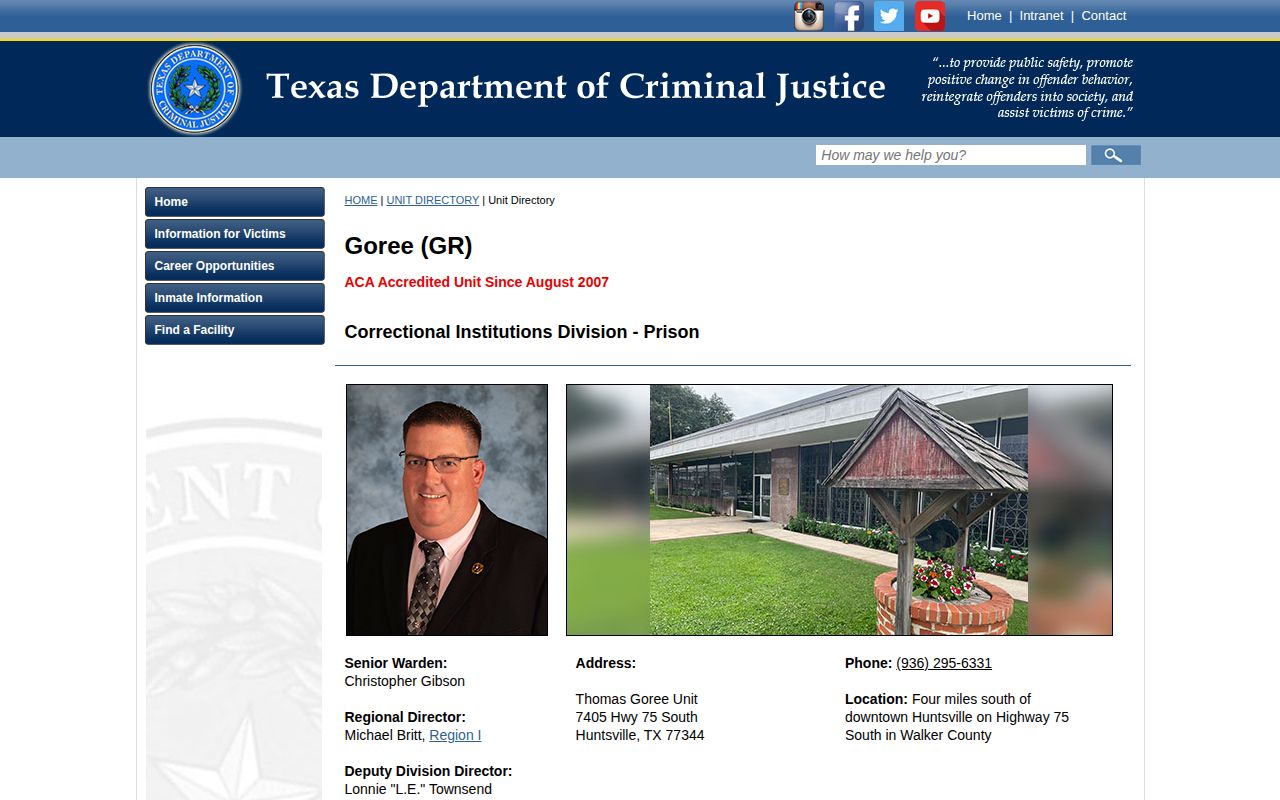
The captured state page ties Goree to TDCJ and supports use of statewide, rather than county-jail, records.
Goree Unit Custody Profile
TDCJ lists Goree as a male state prison with capacity for 1,321 people. Capacity describes the institution. It is not a count of current prisoners, releases, or people expected to leave on a given day. The unit code is GR, which can help when reading state documents or confirming that two records refer to the same facility. Corrections records may use the code more often than the full Thomas Goree name.
A person can enter Goree after conviction in any Texas county. Likewise, that person may later move to another unit based on classification, health, programming, security, or release processing. None of those internal moves is a community release. For a named-person search, the full Walker County released-inmate path explains how county, state, federal, and court records differ on the home page.
Goree Projected Release Dates
TDCJ defines a projected release date as the date Classification and Records estimates release from incarceration if parole does not occur first. Offense date and offense type affect the calculation. For some people, the displayed projection may ultimately be the discharge date. For others, Board review, mandatory-supervision rules, a detainer, loss of good conduct time, or a new court event may change the path. Scheduled and actual release dates are not synonyms.
Texas good-conduct time affects eligibility under state law, but it does not simply erase part of a court sentence. Chapter 498 calls good time a privilege and allows forfeiture for misconduct. Parole eligibility is just the first date on which the Board can consider release. A favorable result still must move through release planning and execution. Only TDCJ should calculate an official date from sentence credit, offense law, concurrent or consecutive terms, judgment findings, and Board action.
- Projected release date
- A TDCJ estimate based on the governing record and law.
- Parole eligibility date
- The point at which Board consideration may begin, not a promised departure.
- Discharge
- Completion of the state incarceration sentence, distinct from an internal transfer.
- Detainer
- A request or legal hold that may route the person to another custodian.
Goree Release Reentry Planning
Goree's manifest research includes the TDCJ Reentry Program. Reentry work can address identification, benefits, housing plans, transport, and links to services before a person leaves state custody. Participation or preparation does not prove that release has happened. It is one stage in a larger process that may still depend on a release certificate, approved plan, transportation, supervision conditions, or another legal hold.
State staff may coordinate family pickup, a bus route ticket, or special transportation to the county of conviction, county of residence, or another approved release county. TDCJ says releases generally occur on weekdays during its published daytime window, excluding holidays, and warns that schedules can change. A family should verify before traveling. That operational rule applies to TDCJ, not to undocumented Walker County Jail timing.
The state reentry source is shown below to connect Goree planning with the agency that administers it.
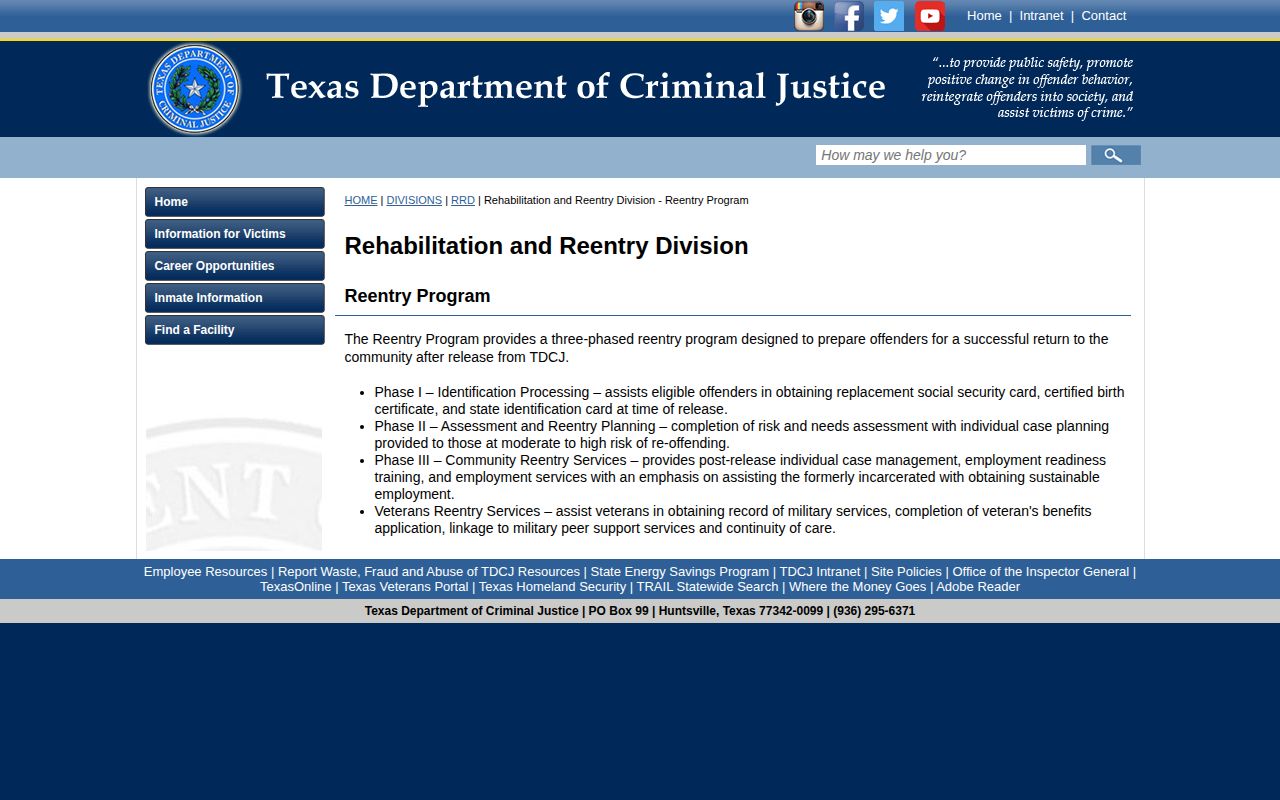
The page supports a planning path, while the offender record and release certificate remain the proof of status.
Goree Release Site Transfers
A person may leave Goree in a secure transfer to Huntsville Unit or another TDCJ site that handles release work. The person is still imprisoned during that move. Huntsville Unit has a regional role for discharge, parole, and mandatory supervision, including specified categories that TDCJ routes there. The gate may therefore be in Walker County even when the conviction and planned residence are elsewhere in Texas.
This is a key local distinction. “Released in Walker County” does not mean “convicted in Walker County.” Seven TDCJ prisons operate in the county, and statewide release work is concentrated here. A Walker Odyssey search may correctly return no county jail event for a man who physically left state custody in Huntsville. Follow TDCJ by person and number, then read the county of conviction and supervision instructions in the state record.
Note: Geography identifies the release site, while the TDCJ record identifies the legal authority and custody event.
Goree Release Versus Transfer
The clearest test is the receiving authority. A community release ends the prison-custody event and may begin parole or mandatory supervision. A transfer sends the person to another TDCJ unit, a county jail, federal authorities, or immigration custody. A detainer can cause an immediate handoff even when the TDCJ sentence event is complete. In that case, the person has left TDCJ custody but has not necessarily entered the community.
| Record result | Meaning |
|---|---|
| New TDCJ unit | Internal custody continues |
| Parole or mandatory supervision executed | State prison release with reporting duties |
| Discharged | State sentence event ended, subject to any other hold |
| Transferred to another authority | Custody continues under the receiving agency |
When the sources conflict, obtain the primary TDCJ record and compare it with the court or receiving-agency record. Search absence alone is weak proof. A name variation, data delay, unit movement, or incomplete historical display can explain it.