
Walker County Parole and Probation
Texas assigns parole and probation to separate systems. The TDCJ Parole Division supervises people released from prison on parole or mandatory supervision. The Texas Board of Pardons and Paroles makes release, condition, and revocation decisions. Walker County Community Supervision and Corrections Department, or CSCD, supervises probation ordered by a county or district court.
A parole client has left prison but is still serving a sentence in the community. Probation is a court sentence served under conditions and may follow a short jail stay or no prison stay at all. Neither status should be inferred from a booking entry.
| Record type | Who decides | Who supervises | Best check |
|---|---|---|---|
| Parole | Texas Board of Pardons and Paroles | TDCJ Parole Division | TDCJ record and Parole Division |
| Mandatory supervision | Texas law and BPP process | TDCJ Parole Division | TDCJ status and release certificate |
| Probation | Sentencing court | Walker County CSCD | Court order and CSCD |
| Discharge | Sentence calculation or court order | No supervision under that sentence | Discharge record or final order |
- Parole
- Conditional release from prison before sentence discharge.
- Probation
- Court-ordered community supervision instead of, or after, confinement.
- Discharge
- Completion of the sentence, including required supervision.
- Absconder
- A client reported as no longer complying with required contact.
Check Walker County Supervision
Start with the sentence source. A Walker County Jail release on bond does not create parole. A transfer from the jail to TDCJ does not place the person in the community. Use identifiers such as a TDCJ or State Identification number, date of birth, case number, and conviction county to avoid a same-name mistake.
- Search the TDCJ Inmate Search for a state-prison record and read location, projected release date, and parole information together.
- Before a Board decision, call the BPP prerelease-review status line at (844) 512-0461. A review or vote is not an executed release.
- After a favorable vote, use the Parole Division release-status line at (512) 406-5202. Supply the TDCJ or SID number or date of birth.
- For probation, read the Walker County judgment and probation order, then contact Walker County CSCD to confirm the correct supervision channel.
- Ask for a discharge record when the issue is whether supervision ended, rather than whether the person left a facility.
The broader Walker County released inmate search explains how to connect the county jail event, court disposition, and state record without treating a roster disappearance as release.
Walker County Supervision Offices
Local assignment matters. A person released through a Walker County prison unit may report elsewhere under an approved plan. The Huntsville District Parole Office is the local verification point only when TDCJ assigns the client there. Probation remains a Walker County CSCD matter.
Huntsville District Parole Office
600 Interstate Highway 45 North
Huntsville, TX 77320
(936) 295-5217
Fax: (936) 435-2603
Walker County CSCD
705 FM 2821 West
Huntsville, TX 77320
PO Box 6910, Huntsville, TX 77342-6910
(936) 435-2458
Monday through Thursday, 8 a.m. to 5 p.m.; Friday, 8 a.m. to 4 p.m.
Central TDCJ Parole Division is at 8610 Shoal Creek Boulevard, Austin, Texas 78757, telephone (512) 406-5250. The district office can clarify routing, but public sources do not provide a complete roster of local parole clients.
The official Huntsville District Parole Office listing shows the local office and its contact route.
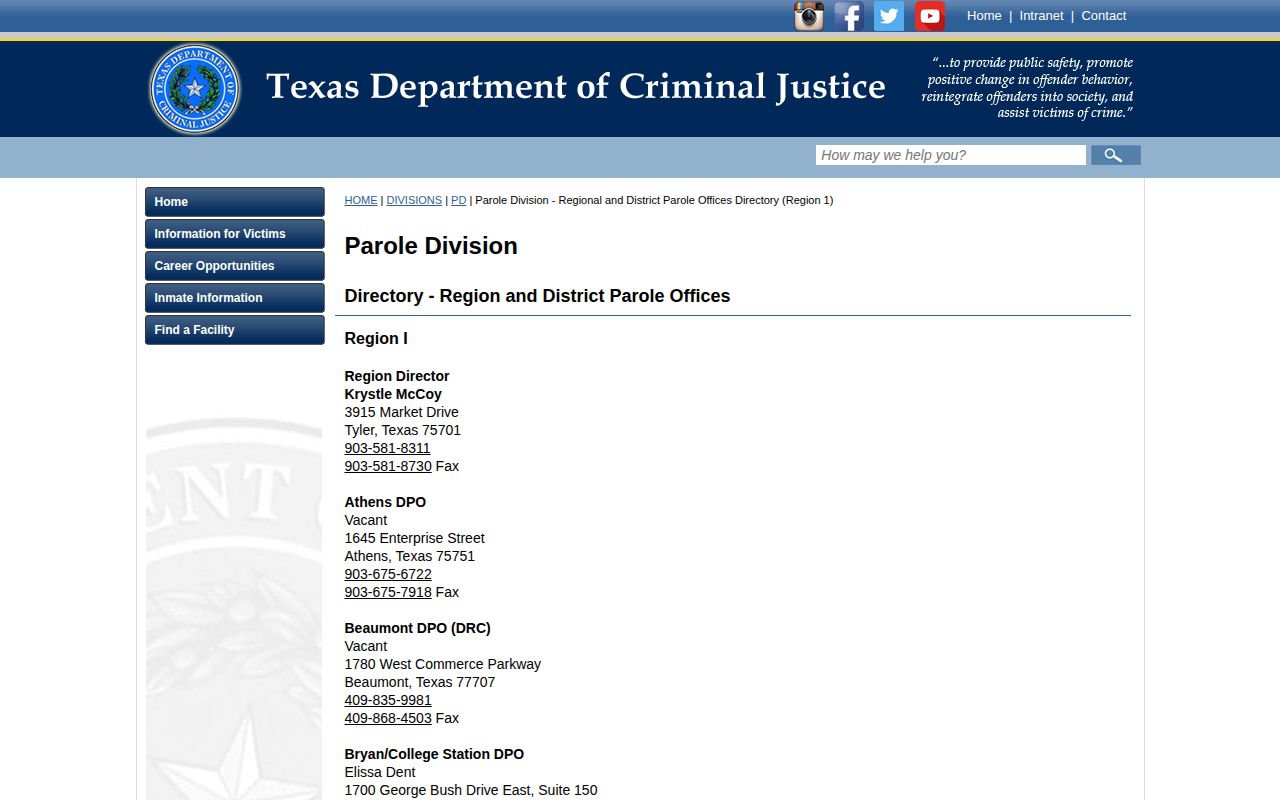
The captured office page helps confirm the agency and address, but assignment to that office still must be checked for the named person.
Walker County Absconder Records
The Walker County CSCD page publishes an absconder channel. It states that listed people stopped reporting and have an active arrest warrant. That is evidence of alleged supervision noncompliance and a warrant. It does not prove the person has been arrested again or is now inside Walker County Jail.
Confirm physical custody through the actual custodian. A warrant can remain active while the person is outside jail, and a current jail entry may relate to another case. The CSCD main and tip line is (936) 435-2458. Give a full name and case details when available, and do not rely on a name alone.
When the person appears in a jail record, compare the booking date, charge, warrant, and releasing authority. A probation warrant can lead to detention, a hearing, reinstatement, modified terms, or revocation. The warrant alone does not reveal which outcome occurred. Read the court docket and custody record together.
Note: Absconder status concerns required reporting; it is not a current-custody locator or proof of a new release.
Walker County Supervision Discharge
Release and discharge answer different questions. Parole or mandatory supervision means the person is outside prison while the sentence continues. A flat discharge means the TDCJ sentence has ended. Probation ends through the terms of the judgment or a later court order, including any lawful early termination.
For parole, request TDCJ incarceration history and actual discharge information. For probation, review the Walker County docket for the original judgment, revocation activity, and final order. Texas Government Code Chapter 508 governs parole and mandatory supervision. The document should control over a stale portal entry.
A Walker County docket may show a motion, hearing, order, or revocation that changed probation. Read it in date order. For state supervision, ask TDCJ for actual release and incarceration history when the public result shows only a projected date. Never call a person discharged merely because the person is no longer at a Walker County unit.
Walker County Reentry Support
Walker County sits at the center of Texas prison release operations. The TDCJ Reentry Program helps eligible people prepare identity documents, benefits applications, and release plans before they leave. Estelle Unit also hosts the Serious and Violent Offender Reentry Initiative. Program placement is preparation, not release.
A release plan may determine the district office, residence, reporting instructions, and transport. The Huntsville Placement and Release Unit works with parole placements, including cases that need special handling. Confirm the executed release and assigned office after processing because the planned date, site, or destination can change.
Walker County Parole Decision Flow
Parole decisions are file reviews, not public courtroom hearings in the ordinary sense. Eligibility starts the review process. The Board may vote for release, deny release, or require a program or condition. Even a favorable decision can be followed by plan approval, program completion, detainer review, and certificate work.
Decision flow: Eligibility → Board review → vote → release-plan processing → physical release → supervision → discharge.
The parole-review line is suited to the earlier stages. The Parole Division release-status line is the better channel after approval. Actual departure should be confirmed through TDCJ, not assumed from the vote.
Conditions differ by decision and release plan. They can address reporting, approved residence, travel, treatment, programs, and other conduct. A public summary may not show each active condition. The controlling certificate and instructions given to the client are the best records. A reported violation also does not cancel the need to check custody. The Board can issue process and decide revocation, while the Parole Division manages supervision and investigation.
Mandatory supervision is not the same as parole even though the Parole Division supervises both. Texas law controls eligibility and review. The displayed projected date, parole eligibility date, Board action, physical release date, and final discharge date should be kept separate in any Walker County record timeline.